Content
Grow visibly thicker, fuller hair
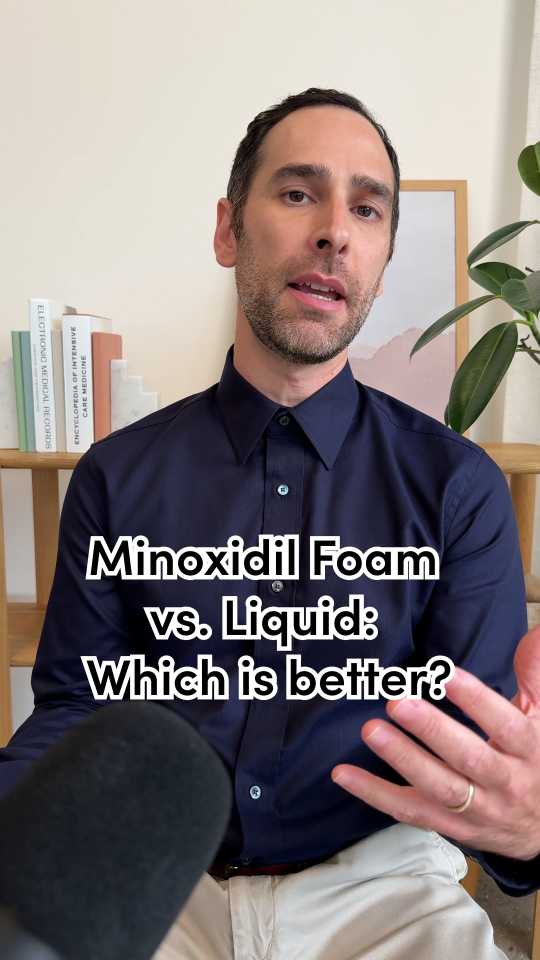
Minoxidil Foam vs Liquid: Which is the Best?

Key Takeaways:
Both minoxidil foam and its liquid form are equally effective for hair regrowth.
Foam may be easier to apply and less irritating, especially for sensitive scalps.
Liquid might better penetrate thick or long hair but can cause more skin irritation.
The best choice comes down to personal preference and hair type.
Topical minoxidil (the generic version of Rogaine Ⓡ ) is an effective, research-backed, FDA-approved medication proven to help people with hair loss due to androgenetic alopecia, or male pattern baldness. But what’s the best way to use it? Minoxidil foam or liquid?
Topical minoxidil is available in two forms: minoxidil foam and minoxidil liquid. They both work in the same way to stimulate the hair growth cycle. But there are a few key differences between them.
Below, we outline what the research says about Rogaine foam vs solution, and what you should consider when deciding between the two.
Content
What Is Minoxidil?
Minoxidil, the generic version of the brand-name product Rogaine, is a topical treatment that helps slow hair loss and stimulate hair growth.
Researchers originally developed minoxidil as a treatment for high blood pressure, then discovered that it caused hypertrichosis (AKA excessive hair growth).
The hair loss treatment hit the market in the 1980s, with higher strength options hitting the shelves in the early 90s.
Today, both the 2% and 5% versions of minoxidil are available over the counter in the United States in liquid (dropper application) or foam (spray application) formulas. In other countries, you may need a prescription.
Even though it’s been around for over 30 years, researchers still don’t know exactly how minoxidil improves hair growth. Some research suggests that topical application improves blood flow, increasing nutrient supply to hair follicles and stimulating hair regrowth.
Bottom line? Minoxidil is an effective hair loss treatment that research shows consistently improves hair growth in men with male pattern baldness and other forms of hair loss.
Is minoxidil foam or liquid better for hair loss?
Research shows that both forms of minoxidil work well for stimulating hair growth and treating hair loss.
One 2016 clinical trial published in the Journal of Drugs in Dermatology compared these two formulations head-on. Researchers concluded that they had almost identical effects on hair growth.
It’s worth noting that this study involved female participants with female pattern hair loss, not males. But, since minoxidil has similar effects on both sexes, we can assume the results would be similar in a study of males with male pattern baldness.
It’s also not the only study that has shown that both liquid and foam versions of minoxidil are similar in effectiveness. And there’s not really any evidence that suggests one works better than the other.
Furthermore, more recent studies (post-2016) have also shown near-identical outcomes for both foam and liquid.
So how can you decide between the two? Here’s a handy comparison at a glance.
Minoxidil Foam vs. Liquid: Side-by-Side Comparison
Below, you’ll find a side-by-side comparison of minoxidil foam and minoxidil liquid, with expert insight from one of our medical reviewers, board-certified dermatologist Knox Beasley, MD.
Ease of Application | Convenience | Absorption | Effectiveness (after 24 weeks of treatment) | Side Effects | |
|---|---|---|---|---|---|
Minoxidil Foam | Foam is easier to use if you have short hair or severe thinning | Tends to score higher in ease of use | Foam absorbs more quickly | Increase of 23.9 hairs per square centimeter | Unlikely to cause skin irritation |
Minoxidil Liquid | Minoxidil solution (liquid) might be easier to apply to long or very thick hair | It may be messier to apply | It may take longer for the skin to absorb | Increase of 24.2 hairs per square centimeter | Propylene glycol in liquid minoxidil can cause irritation, including red, itchy, or sensitive skin |
Our Expert’s Verdict | “Both formulations are easy to apply, but hair length and thickness may impact your choice,” says Dr. Knox Beasley. | “Deciding to use the foam vs the liquid comes down to personal preference. Some people like the foam and others prefer the liquid. The foam is typically easier to apply to larger areas of the scalp than the liquid.” | “The foam absorbs faster than liquid.” | “Both the foam and the liquid are equally effective.” | “The foam is less likely than liquid to cause skin irritation.” |
When considering whether to choose minoxidil foam or liquid, it ultimately comes down to personal choice. But here are some pros and cons of the topical medication forms to help you decide.
Formulation | Pros | Cons |
|---|---|---|
Minoxidil Foam |
|
|
Minoxidil Liquid |
|
|
“Both the foam and liquid version of minoxidil are equally effective. It comes down to if you would prefer to use a liquid or a foam. If you have a sensitivity to propylene glycol then the foam is a better option,” says Dr. Knox.
“It may be helpful to try one then the other to see which works better for your scalp.”
Minoxidil is a highly effective hair loss treatment, but it won’t do much good if you don’t use it correctly.
Follow these tips and techniques for optimal results:
Apply it correctly. Using minoxidil is easy, but preparing your hair and scalp before application is essential. Our guide lists step-by-step instructions for properly applying minoxidil solution vs foam.
Be consistent. You’ll get the best results when using minoxidil twice a day. Need help sticking to your hair care routine? Try setting a notification on your phone or keeping the product in a prominent spot.
Use it with finasteride. Minoxidil works well on its own, but research shows it’s more effective when combined with finasteride. Minoxidil stimulates hair growth, and finasteride blocks the hormone dihydrotestosterone (DHT), which causes male pattern hair loss. Unlike minoxidil, finasteride requires a prescription. We offer both medications as part of our Hair Power Pack and a topical finasteride & minoxidil spray power duo.
FYI: Be prepared to wait three to six months for results. Minoxidil works, but it can take time to see its effects. In fact, it’s common to experience hair shedding in the first few months of minoxidil use, so don’t panic if you notice this symptom.
Using Minoxidil Foam vs Liquid
Choosing between foam and liquid minoxidil mostly comes down to what works best for your scalp and routine. Both are effective, but your experience may vary.
The foam version of minoxidil is less irritating for most users since it doesn’t contain propylene glycol.
Liquid versions may work better for those with longer or denser hair, thanks to their precision dropper.
Both options can be effective for the treatment of androgenetic alopecia and promote hair regrowth.
Beyond this, it all comes down to personal preference. If you use minoxidil regularly, consider trying both versions. You may also want to talk to a healthcare professional, like a dermatologist, to discover the right dosage for your needs and provide personalized medical advice.
You might also consider oral minoxidil or other products like biotin supplements — Hims offers several.
Not sure where to start? Our free hair quiz helps match you with the best hair loss treatment options, including foam, liquid, and more advanced possibilities.
7 Sources
- Blume-Peytavi U, et al. (2016). Efficacy and safety of once-daily minoxidil foam 5% versus twice-daily minoxidil solution 2% in female pattern hair loss: A phase III, randomized, investigator-blinded study. https://pubmed.ncbi.nlm.nih.gov/27391640/
- Friedman ES, et al. (2002). Allergic contact dermatitis to topical minoxidil solution: Etiology and treatment. https://pubmed.ncbi.nlm.nih.gov/11807448/
- Hu R, et al. (2015). Combined treatment with oral finasteride and topical minoxidil in male androgenetic alopecia: A randomized and comparative study in Chinese patients. https://pubmed.ncbi.nlm.nih.gov/26031764/
- Patel P, et al. (2025). Minoxidil. https://www.ncbi.nlm.nih.gov/books/NBK482378/
- Purnak T, et al. (2011). Liquid formulation of minoxidil versus its foam formulation. https://pmc.ncbi.nlm.nih.gov/articles/PMC3179030/
- Rundegren J. (2004). A one-year observational study with minoxidil 5% solution in Germany: Results of independent efficacy evaluation by physicians and patients. https://www.jaad.org/article/S0190-9622(03)03692-2/fulltext
- Suchonwanit P, et al. (2019). Minoxidil and its use in hair disorders: A review. https://pmc.ncbi.nlm.nih.gov/articles/PMC6691938/
Editorial Standards
Hims & Hers has strict sourcing guidelines to ensure our content is accurate and current. We rely on peer-reviewed studies, academic research institutions, and medical associations. We strive to use primary sources and refrain from using tertiary references. See a mistake? Let us know at blog@forhims.com!
This article is for informational purposes only and does not constitute medical advice. The information contained herein is not a substitute for and should never be relied upon for professional medical advice. Always talk to your doctor about the risks and benefits of any treatment. Learn more about our editorial standards here.
Related Articles
Related Conditions
 Hair Loss
 Male Pattern Baldness
 Dandruff

 Scarring Alopecia
 Seborrheic Dermatitis