Content
Boost testosterone with personalized treatment plans
Do At-Home Testosterone Tests Work?

Key Takeaways:
At-home testosterone tests offer a convenient way to test for low testosterone. Blood lancet devices, like the Tasso® in the Hims at-home testosterone testing kit, tend to provide consistent and reliable results when used correctly.
Timing and technique matter. Testosterone peaks in the morning, so testing early in the day, in addition to following the kit’s instructions carefully, helps ensure accurate results.
Results are just a starting point. An at-home testosterone test can flag potential hormone issues, but only a healthcare provider can confirm a case of low T and recommend treatment.

Taking an at-home testosterone test is a convenient way to assess your hormonal health. But not all testing kits are created equally, and when and how you test can noticeably affect your results.
Hims offers comprehensive at-home testosterone testing and, if appropriate, access to various provider-prescribed testosterone treatment options for men dealing with low testosterone. Keep reading to find out how the at-home testosterone test works, what the test measures, and what to do once you receive your results.
Content
A variety of at-home testosterone tests are available for you to order online or buy from a local pharmacy. These tests may require you to provide a blood sample via a finger prick or a saliva sample, which you can mail to a lab for analysis. Hims offers at-home testosterone testing with a blood lancet device. This type of sample can reduce some of the variability seen with small finger-prick samples and may offer more consistent results when compared with some other at-home methods.
At-home testosterone tests typically measure total testosterone levels. Total testosterone includes both free testosterone (biologically active) and testosterone bound to proteins like sex hormone-binding globulin (SHBG) and albumin.
Some tests may measure other hormones and proteins that influence testosterone for a more detailed analysis of your hormone health. These additional biomarkers may include SHBG, luteinizing hormone (LH), albumin, and more.
Different tests have their own instructions for how to test your testosterone at home. For instance, Hims offers at-home blood testing, but some tests ask for saliva samples. With whichever option you choose, though, it’s best to conduct your test in the morning when testosterone levels are highest. Studies show that in men aged 30 to 40, testosterone levels can be up to 25 percent lower in the late afternoon (around 4 p.m.) compared to early-morning levels (around 8 a.m.)
Read the testing kit packet thoroughly to ensure you collect the sample correctly. The exact instructions will vary depending on your specific kit, but here are some tips for using various methods.
Blood Lancet Test
If you order an at-home testing kit from Hims, you’ll receive a Tasso® device, which is a blood lancet. Blood lancets are single-use testing devices that collect whole liquid blood samples from the upper arm. Many people consider blood lancets as more comfortable to use than finger-prick methods.
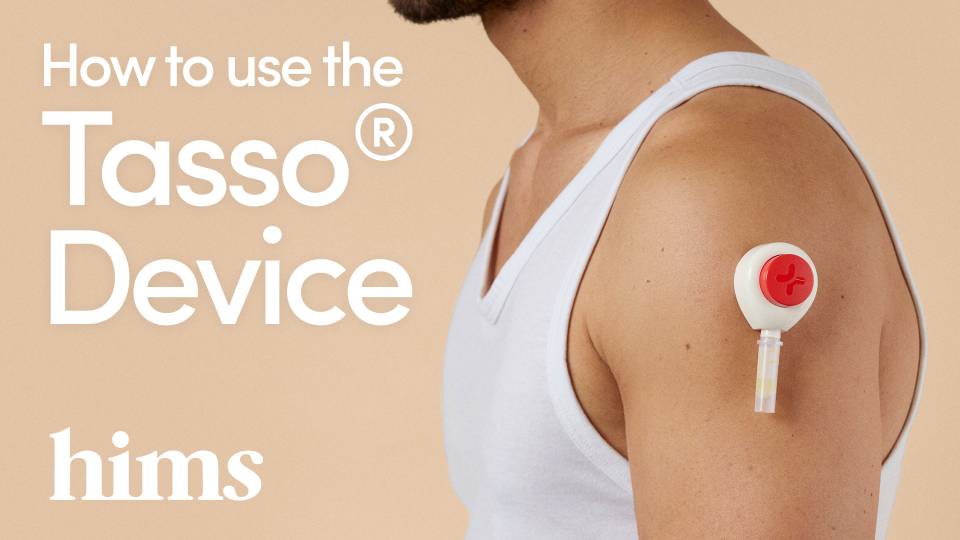
Here’s how to use the Tasso®:
Prep the area. Before you test, wash your hands, roll up your sleeves to expose your upper arm, and shave the area where you’ll be drawing blood. To promote blood circulation, rub this area for two minutes and use the provided heat pack for four minutes. Then, use the provided alcohol swab to disinfect the prepped area.
Prep the device. Remove the Tasso® device from its tray and attach the blood collection tube as shown in the instructions. Then, remove the clear label from the device’s red button.
Collect your sample. To collect your sample, peel the tab away from the Tasso® device to reveal its sticky side. Then, attach the Tasso® directly to the meaty part of your upper arm while you let your arm hang straight down. Press the red button and hold it down for three seconds, and then release.
Set a timer. If your tube has a purple cap, let it fill for two to three minutes. If it has a yellow cap, let it fill to the top line for up to five minutes. Please note that blood may not flow immediately.
Remove the device. Carefully peel the Tasso® device from one side of the skin and apply a bandage. Apply slight pressure to stop the flow of blood. Then, remove the tube from the device, replace the cap until it clicks, flip the tube over, and give it a flick. Flip it back and forth about 10 times to mix the blood sample.
Repeat the test on the other arm. Follow each of these steps again to repeat the test on the other arm.
Send your sample to the lab. Once you’ve collected your sample, place your tubes in the provided biohazard bag and press to seal. Fill out the provided collection card and place it in the same box in which your kit arrived, along with the filled tubes. Apply the provided shipping label and ship via FedEx to the lab the same day.
Finger-Prick Test
If you use a finger-prick blood test for a capillary sample, testing steps may include:
Prep with a hot shower or bath. Hot water aids circulation, which is helpful when drawing blood from your fingertip.
Clean the testing area with alcohol. Choose which finger you’re going to prick, clean the testing area with alcohol, and let your fingertip air-dry.
Puncture the skin. Using one quick and deliberate stroke, puncture the skin on your fingertip to achieve a good flow of blood, and collect the droplet as instructed in the testing kit packet. Avoid excessive squeezing or “milking” of the finger, which can dilute the sample with fluid from surrounding tissues
Apply pressure. Once you’ve collected your sample, apply firm pressure to stop the blood flow.
Mail in your sample. Follow the instructions on how to send your sample collection to the lab safely.
Saliva Test
With an at-home saliva test, you may then be asked to:
Avoid drinking, eating, smoking, or vaping. Fast for at least 30 minutes to an hour before taking the test. Don’t smoke, vape, or drink anything other than water.
Rinse your mouth. Before providing your sample, rinse your mouth with clean drinking water. Be sure to swish around and spit out the water completely.
Fill the collection tube with saliva. Be sure to provide enough saliva, as indicated in the instructions. You may have to shake the collection tube to reduce foam.
Freeze your sample. Most saliva testing kits require you to freeze your sample for a few hours before shipping it to the lab.
Most studies focus on testing that healthcare professionals perform in a clinical setting. For this reason, research is limited on the efficacy of at-home tests, but they may be more prone to user error. Someone taking the test for the first time might not follow the steps as precisely as a trained professional.
When performed correctly, though, at-home testosterone tests can provide accurate first insights into hormone levels. But some tests may be more reliable than others.
For instance, a small study on finger-prick blood tests (not measuring testosterone)concluded that small drops of blood from a finger prick provide less reliable results than blood from a vein. Specifically, results for hemoglobin and platelets vary as much as three to eight times more with the finger-prick model.
On the other hand, blood lancet tests appear to produce accurate and consistent test results and user-friendly blood collection. Research on the Tasso® device also concludes that users prefer the blood lancet over finger-pricking, noting it to be more comfortable.
Saliva tests are arguably the most convenient and easy to collect option, though this form of test may offer limited information about your hormone health. Research on salivary testosterone tests concludes that saliva only contains the free, biologically active testosterone, so saliva tests usually do not provide total testosterone levels. Because guidelines for diagnosing low testosterone are based on total testosterone, saliva results alone are generally not enough to make a low T diagnosis.
Don’t jump to conclusions about having low testosterone or hypogonadism (which describes when the testes don’t produce enough male sex hormones) based on a single test result.
The American Urological Association (AUA) defines low testosterone as a level below 300 nanograms per deciliter (ng/dL). A diagnosis of low T requires two separate early-morning blood tests on different days showing consistently low testosterone and symptoms of testosterone deficiency.
“A single testosterone test result is just one piece of the puzzle,” says Mike Bohl, MD, a general practitioner and the Senior Director of Medical Content & Authority at Hims & Hers. “Often, providers will order a second confirmatory test — especially since testosterone levels can vary.”
Dr. Bohl adds that, beyond doing due diligence with testing, it’s crucial to connect with a healthcare professional about your results. Your provider can help you understand the numbers in the context of your overall health and any symptoms you’re experiencing.
“Some men might have low testosterone levels on a lab test but no symptoms, in which case treatment might not be recommended,” Dr. Bohl says. “Other men might have testosterone levels that are technically in the healthy range, but they do have symptoms, in which case a provider can help determine what steps to take next.”
Think of your at-home testosterone test as a first step, not the final answer. It isn't just about seeing a number, but rather it’s a tool to help you and your healthcare provider determine whether your symptoms might be related to your testosterone levels and guide the next steps in managing your health.
A number of factors can influence the results of an at-home testosterone test. These include:
Timing. Testosterone levels peak in the morning, so if you take a test later in the day, your results may be lower than your early-morning levels.
Hygiene. Eating or drinking before you provide a saliva sample, forgetting to wash your hands, or storing your sample improperly can all lead to inaccurate test results. You must follow the instructions of your testosterone test kit closely.
Lab processing. Most at-home testing services process samples in a clinical laboratory certified by the Clinical Laboratory Improvement Amendments (CLIA), but double-check to make sure this is true for your sample. The CLIA certification requires that labs adhere to strict federal and state standards.
When it comes to choosing an at-home testosterone test, the “best” kit really depends on your comfort level and the insights you’re hoping to see.
When it comes to at-home blood tests in general, finger-prick testing kits are common, but some studies show that results from small drops of blood from the fingertip may be less consistent. Saliva tests are notably convenient, but they provide limited data on testosterone levels as they only measure free testosterone.
Blood lancet devices that draw from the upper arm tend to generally provide consistent results, often comparable to venous blood, and have been rated as easier and less painful to use.
You may want to test your testosterone levels if you’re experiencing symptoms of low testosterone levels or high testosterone levels.
Signs of low testosterone:
Low sex drive
Erectile dysfunction (ED)
Loss of muscle mass
Increased body fat
Low bone density
Less body hair
Low energy levels
Brain fog
Mood changes
Infertility
Meanwhile, signs of high testosterone levels might show up as acne, hair loss, mood swings, or insomnia.
Taking an at-home testosterone test saves you the hassle of having to schedule and go to an in-person appointment. But are the results just as accurate as the in-clinic option?
Here’s what we know:
At-home testosterone tests can give helpful insights, but accuracy depends on the testing method. Finger-prick samples are prone to variability, and saliva tests only measure free testosterone. Blood lancet devices, such as the Tasso® device available through Hims, can provide consistent samples and are often rated as user-friendly.
Timing and technique matter. Since testosterone peaks in the morning, testing early in the day and following kit instructions closely (whether for blood or saliva) helps to ensure more accurate results.
Your results are just the starting point. An at-home test can flag potential hormone issues. But only a healthcare professional can confirm low testosterone, rule out other causes, and recommend treatment if necessary.
Want to learn more about optimizing your hormone health? Read about how to increase testosterone naturally, learn the truth about testosterone boosters, and explore the link between testosterone and body composition.
FAQs
Here are answers to frequently asked questions about at-home testosterone tests.
How long does it take to get results from an at-home testosterone test?
Most kits provide results within a few days to a week after the lab receives your sample. Some services also offer digital portals to view your results securely online.
Are at-home testosterone tests covered by insurance?
At-home testosterone tests are rarely covered by insurance, though some testing services may let you pay using a flexible spending account (FSA) or health savings account (HSA). Lab testing through Hims does not require insurance, and we don’t currently take FSA or HSA plans as payment.
What are abnormal testosterone levels?
Normal testosterone levels in men range from 300 to 1,000 ng/d, but many labs list a reference range that begins around 300 ng/dL and extends up to roughly 800–1,000 ng/dL. Anything outside that range may be considered abnormal. The American Urological Association defines testosterone deficiency as below 300 ng/dL.
What happens if my results show low levels of testosterone?
An at-home test is only the first step in improving your hormonal health. If your results indicate low testosterone, you should consult a healthcare provider. They may order follow-up tests, check related hormones, rule out other health conditions, and review your symptoms before confirming a low T diagnosis or recommending treatment.
Depending on the cause of low testosterone and your overall health, treatment may include options like testosterone replacement therapy (TRT), enclomiphene citrate, or human chorionic gonadotropin (hCG) prescribed by a qualified provider. Your healthcare professional will discuss the potential risks, benefits, and regulatory status of each option with you.
This article is for informational purposes only and does not constitute medical advice. The information contained herein is not a substitute for and should never be relied upon for professional medical advice. Always talk to your doctor about the risks and benefits of any treatment. Learn more about our editorial standards.
5 Sources
- American Urological Association (AUA). (2024). Evaluation and management of testosterone deficiency (2024). https://www.auanet.org/guidelines-and-quality/guidelines/testosterone-deficiency-guideline
- Bond ME, et al. (2015). Drop-to-drop variation in the cellular components of fingerprick blood: implications for point-of-care diagnostic development. https://academic.oup.com/ajcp/article-abstract/144/6/885/1761216
- Jett JU, et al. (2023).Validation of the quantification of phosphatidylethanol 16:0/18:1 concentrations in TASSO-M20 devices. https://pubmed.ncbi.nlm.nih.gov/36811188/
- Keevil B, et al. (2016). Salivary testosterone measurement by liquid chromatography tandem mass spectrometry in adult males and females. https://pmc.ncbi.nlm.nih.gov/articles/PMC5029560/
- World Health Organization (WHO). (2010). Capillary sampling. https://www.ncbi.nlm.nih.gov/books/NBK138654/
Editorial Standards
Hims & Hers has strict sourcing guidelines to ensure our content is accurate and current. We rely on peer-reviewed studies, academic research institutions, and medical associations. We strive to use primary sources and refrain from using tertiary references. See a mistake? Let us know at blog@forhims.com!
This article is for informational purposes only and does not constitute medical advice. The information contained herein is not a substitute for and should never be relied upon for professional medical advice. Always talk to your doctor about the risks and benefits of any treatment. Learn more about our editorial standards here.