Provided by You Health for patients - Terms & Conditions

Stendra®

The following medication overview provides an overview of Stendra®, how it works, and how to effectively and safely use it to enhance erection strength and quality. You will also receive a physical document called a drug monograph or patient drug information in the package with your medication when it arrives from the pharmacy which contains full information about Stendra® — you should read all of the information that comes with your prescription shipment before taking your medication.

How Stendra® works

Stendra® belongs to a class of medications called phosphodiesterase 5 inhibitors. The active ingredient is called avanafil. These medications increase responsiveness to sexual stimulation and arousal by increasing blood flow to the penis. They work by blocking the enzyme (phosphodiesterase 5) that turns off an erection.

In this medication overview
  • 1

    Usage

    How to get the most out of your treatment

  • 2

    Side Effects

    What to look out for when using your treatment

  • 3

    Warnings

    Important safety information

Usage

Tips for Stendra® use

How to get the most out of your ED treatment.

  • 1

    Timing is key

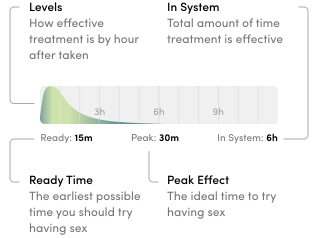
    The effect of Stendra® on sexual performance depends directly on your blood level of Stendra® during sexual activity. Understanding how that blood level changes over time is critical so that you can optimize your performance. Stendra® starts to work within 15 minutes, provides maximal support for sexual function 30-40 minutes after you take it, and lasts for up to 6 hours (see below).
  • 2

    Pay attention to meals

    You can take Stendra® with or without food, but taking it after a meal can result in less absorption of the medication into your body. Food also delays the time to peak effect by 1-1.5 hours.

  • 3

    Consider a practice run

    Trying your first one or two doses in a less pressured, more relaxed environment (i.e. during masturbation) can help you to understand how the medication affects your body and whether or not any treatment adjustments might be helpful before primetime. Stendra® can cause small declines in your blood pressure that may cause dizziness, lightheadedness or even fainting in people sensitive to blood pressure changes. Be sure that you are well-hydrated and in a safe, controlled environment the first time that you take Stendra®.

  • 4

    Give Stendra® a few chances

    It can take some time for your body to acclimate to Stendra®, so don’t rush to conclusions about whether or not it works. Things like alcohol consumption, fatigue, anxiety, and arousal can also affect sexual performance on any given day, even when you take medication to enhance sexual function.

  • 5

    Get in the mood

    Stendra® works by enhancing and strengthening your body’s response to sexual stimulation and arousal. Some kind of mental or physical trigger is still required to kick off your body’s sexual response.

  • 6

    Find the right dose for you

    If you aren’t getting good enough results with one tablet, check your prescription instructions to see if your prescription says “take 1-2 tablets.” If it does, that means that your provider cleared you up front to double your dose at home. If that’s the case and you didn’t experience bothersome side effects with one tablet, go for it with the higher dose. If your prescription instructions say “take 1 tablet” then you will need to reach out to your Care Team to see if a higher dose is safe and appropriate.

Tell your healthcare providers

Tell all your healthcare providers that you take Stendra®. If you need emergency medical care for a heart problem, it will be important for your healthcare provider to know when you last took Stendra®.

Alcohol

It is OK to drink alcohol when taking sildenafil, but not too much. Drinking more than 2-3 glasses of wine, beers, or shots of hard alcohol can increase your chances of headache, dizziness, fast heart rate, and low BP. Alcohol can also inhibit your erection.

Side Effects

Most common

The most common side effects with Stendra® are: headache, indigestion, back pain, visual changes (such as blurry or blue tinted vision), muscle aches, flushing, and stuffy or runny nose. These side effects usually go away after a few hours.

Rare but serious side effects
  1. An erection that won’t go away (priapism) If you have an erection that lasts more than 4 hours, get medical help right away. If it is not treated right away, priapism can permanently damage your penis.

  2. Sudden vision loss Sudden vision loss in one or both eyes can be a sign of a serious eye problem called non-arteritic anterior ischemic optic neuropathy (NAION). It is uncertain whether PDE5 inhibitors directly cause the vision loss. Stop taking Stendra® and call your healthcare provider right away if you have sudden vision loss in one or both eyes.

  3. Sudden hearing decrease or loss Some people may also have ringing in their ears (tinnitus) or dizziness. If you have these symptoms, stop taking Stendra® and contact a provider right away.

  4. Other reported serious side effects It is not known if Stendra® caused these problems, but other serious medical events that have been reported after Stendra® use include: heart attack, stroke, irregular heartbeats, seizures and death.

Where to find more side effects information

For more information, read the drug information that comes with your medication, ask your healthcare provider, or ask your pharmacist.

Warnings

Do not take more than your prescribed dose of Stendra® in a 24 hour period.
Who should not take Stendra®
  • Anyone taking medicines called nitrates (such as nitroglycerin)

  • Anyone using street drugs called "poppers" such as amyl nitrate or butyl nitrate

  • Anyone taking medicines called guanylate cyclase stimulators such as riociguat (Adempas)

  • Anyone allergic to sildenafil or any of the ingredients in Stendra®

If you’re taking any alpha blocker medication, please ensure that you space out your alpha blocker and your ED medication by at least four hours. Taking both of these medications at the same time may cause a severe risk of low blood pressure. Preferably, take your alpha blocker at bedtime. If you’re unsure if one of the medications you’re taking is considered an alpha blocker, please reach out to your Care Team.

When to stop sexual activity

Stop sexual activity and seek medical help right away if you experience chest pain, dizziness, or nausea during sex after taking Stendra®. Sexual activity can put an extra strain on your heart, especially if your heart is already weak from a heart attack or heart disease.

Stop taking Stendra® until you connect with us or a healthcare provider if any of the following conditions or events develop during treatment:
  • Heart problems such as angina, heart failure, irregular heartbeats, or heart attack.

  • Pulmonary hypertension

  • Very low or very high blood pressure

  • Stroke

  • Liver problems

  • Kidney problems or require dialysis

  • Retinitis pigmentosa, a rare genetic (runs in families) eye disease

  • Vision loss

  • Stomach ulcers

  • Bleeding problems

  • Deformed penis shape or Peyronie’s disease

  • Erection lasting more than 4 hours

  • Blood problems such as sickle cell anemia, multiple myeloma, or leukemia

Stop taking Stendra® until you connect with us or a healthcare provider if you start any of the following medications during treatment:
  • Medicines called nitrates like nitroglycerin or isosorbide

  • Medicines called guanylate cyclase stimulators such as riociguat (Adempas)

  • Medicines called alpha blockers such as Hytrin (terazosin), Flomax (tamsulosin), Cardura (doxazosin), Minipress (prazosin), Uroxatral (alfuzosin), Jalyn (dutasteride and tamsulosin), or Rapaflo (silodosin). Alpha-blockers are sometimes prescribed for prostate problems or high blood pressure. In some patients, the use of sildenafil with alpha-blockers can lead to a drop in blood pressure or to fainting.

  • Medicines called HIV protease inhibitors, such as ritonavir (Norvir), indinavir sulfate (Crixivan), saquinavir (Fortovase or Invirase) or atazanavir sulfate (Reyataz)

  • Some types of oral antifungal medicines, such as ketoconazole (Nizoral), and itraconazole (Sporanox)

  • Some types of antibiotics, such as clarithromycin (Biaxin), telithromycin (Ketek), or erythromycin

  • Other medicines that treat high blood pressure

  • Other medicines or treatments for ED

  • Dietary supplements that contain nitrates that are intended to boost nitric oxide production, including but not limited to arginine nitrate, citrulline nitrate, creatine nitrate, and sodium nitrate

Telemedicine Disclosure